Is Your Card Worth Grading? How AI Tells You Before PSA Does
Every collector has asked the same question: "Should I grade this card?" The wrong answer costs you $30+ and weeks of waiting. Here's how to know — in 30 seconds, from your phone.
The $30 Gamble
Submitting a card to PSA costs at least $30. Add shipping, insurance, and the 4-8 week wait, and you're investing real time and money on every submission. If your card comes back a PSA 7 instead of the PSA 10 you were hoping for, you've lost money — the grading fee alone might exceed the card's graded value.
The problem? Most collectors can't tell the difference between a 9 and a 10 with their eyes alone. The defects that separate those grades — micro-scratches, slight edge whitening, centering drift of a few percentage points — are invisible under normal lighting.
What If You Could Know the Grade First?
That's exactly what SlabReady does. Instead of guessing, you scan your card from 9 different angles — the same angles a PSA grader inspects under a loupe. The AI analyzes centering, corners, edges, and surface across every angle and gives you:
- A predicted PSA grade with confidence percentage
- A visual defect map showing exactly where issues are
- Sub-grade scores for all 8 checkpoints (4 front, 4 back)
- A financial breakdown — raw value, graded value at each grade, expected profit or loss
Real Example: Luka Dončić Hot Stars Prizm
Here's a 2024-25 Panini Select Luka Dončić Hot Stars Prizm parallel, numbered #51/75. This is a premium card — but is it worth the grading fee?
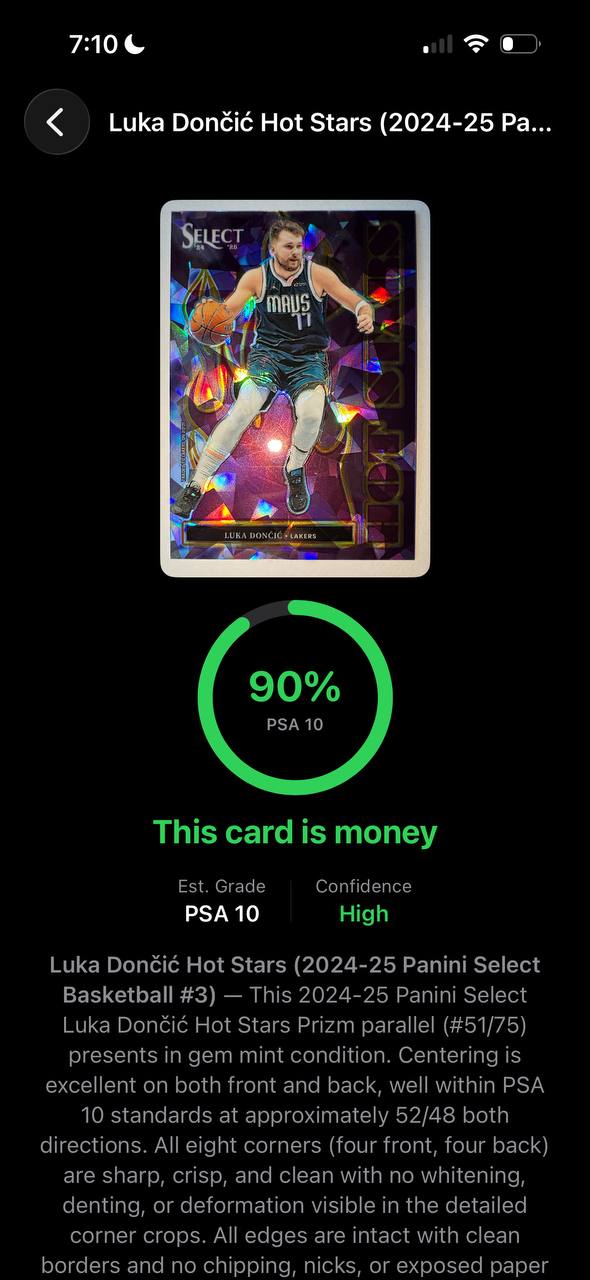
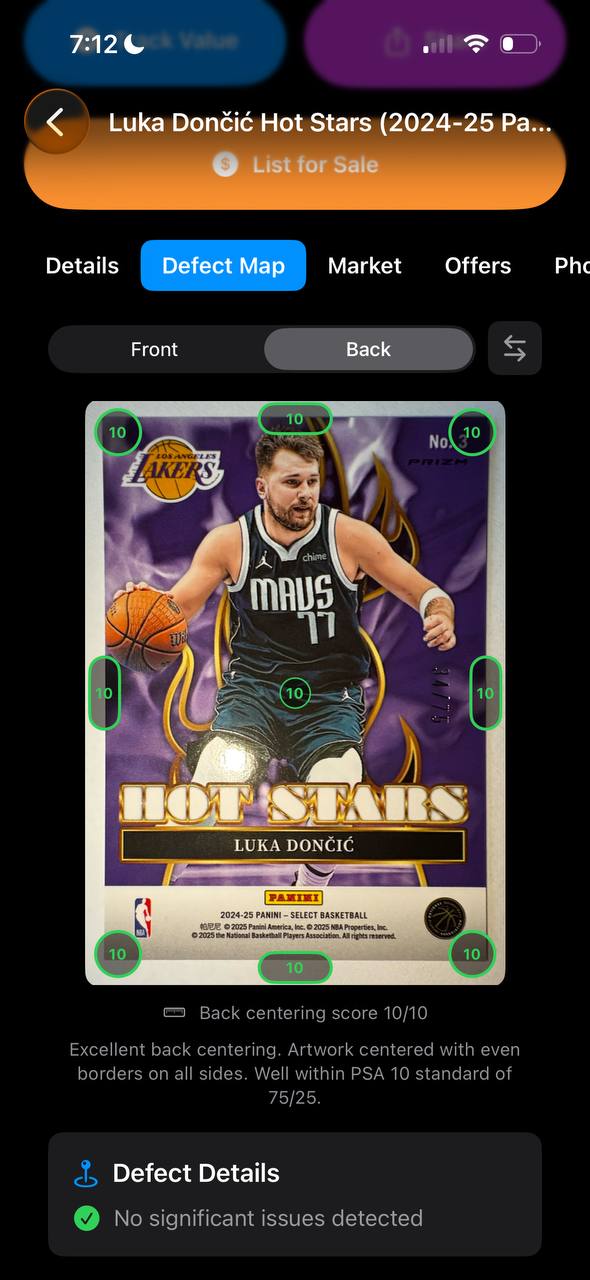
Left: SlabReady's grade prediction — PSA 10, 90% confidence. Right: The defect map with all 10s.
SlabReady scanned it from 9 angles and returned: PSA 10, 90% confidence — "This card is money."
The defect map confirms it: all 8 corner checks scored 10. Back centering is 75/25, well within PSA 10 standards. Centering on front is approximately 52/48 — excellent. No whitening, no denting, no deformation. No significant issues detected.
For a /75 Prizm parallel of Luka, a PSA 10 is worth significantly more than raw. This card is absolutely worth grading.
Already Graded? Scan the Slab.
SlabReady doesn't just grade raw cards. It can also instantly identify graded cards in slabs — just point your camera at a PSA, CGC, or BGS slab and it reads the label, pulls the certification number, and adds it to your portfolio.
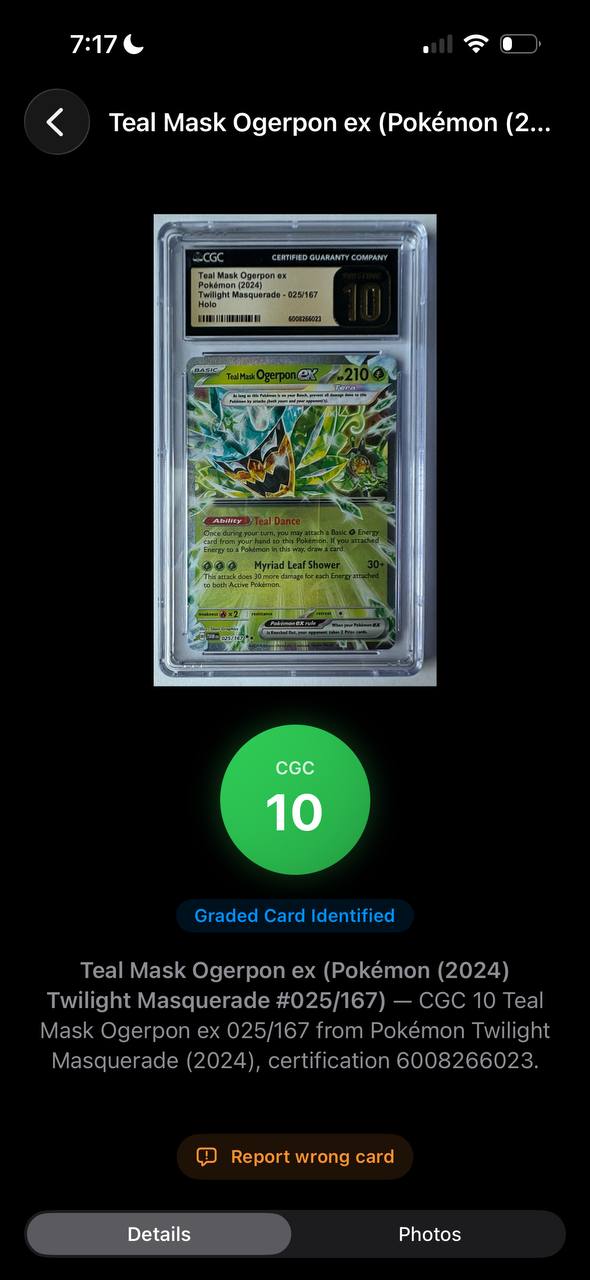
SlabReady instantly identified this CGC 10 Teal Mask Ogerpon ex — certification 6008266023.
This CGC 10 Teal Mask Ogerpon ex from Pokémon Twilight Masquerade (2024) was identified in seconds. No manual entry, no typing cert numbers — just point and scan. It's now tracked in the portfolio with live market pricing.
The Decision Framework
Before submitting any card to PSA, BGS, or CGC, ask yourself:
✅ Grade it if:
- SlabReady predicts PSA 9 or 10 with high confidence
- The graded value minus the grading fee is significantly more than raw value
- The card has a high PSA 10 gem rate (check pop data)
- You plan to sell, and buyers pay a premium for slabs
❌ Don't grade if:
- SlabReady predicts PSA 8 or below
- The profit margin after grading fees is less than $20
- The card has a very high gem rate (PSA 10 isn't rare for this card)
- You're keeping it for your personal collection
Why 9 Angles Matter
Most card grading apps take 1-2 photos. That's like a doctor diagnosing you from across the room. PSA graders inspect cards under magnification from every angle — tilting to catch surface haze, examining edges for micro-chipping, checking corners for whitening that only shows at certain angles.
SlabReady's 9-angle guided capture replicates this process. The app auto-detects your card and walks you through flat shots, tilts, back, and corner views. Photos capture automatically when aligned. The whole process takes less than 30 seconds.
The result: SlabReady catches defects that single-photo apps miss entirely — the same defects that turn your expected PSA 10 into a disappointing 8.
Stop guessing. Start knowing.
3 free deep scans. No subscription. No account required.
Scan Your First Card FreeWhat Dealers Are Using It For
It's not just collectors. Card shops and dealers are using SlabReady to:
- Quick Buy at shows: Snap a photo, identify the card, make an offer, and accept payment via Venmo/CashApp/PayPal in 10 seconds
- Pre-screen collections: Someone brings in a binder? Scan the whole page, flag PSA 10 candidates worth $30+, and know exactly what to buy
- Price with confidence: Get an AI grade prediction before setting your price on raw cards
- Track sales: Every transaction logged with photo, price, and payment method
No fees, no middleman. Payments go directly to your existing accounts.
Frequently Asked Questions
How much does it cost to grade a card with PSA?
PSA grading starts at $30 per card for their Value tier (cards worth under $499). Express services run $75-$150+, and Super Express is $300+. On top of that, you'll pay shipping both ways plus insurance. That's why pre-screening with an AI grading app like SlabReady saves real money — you only submit cards likely to grade well.
How accurate is AI card grading compared to PSA?
AI card grading accuracy depends heavily on the app. Single-photo apps are limited — they can't detect surface defects or edge whitening that only shows at certain angles. SlabReady's 9-angle scan catches the same defects PSA graders find under loupes. For centering specifically, AI is often more technically precise than human graders because it measures pixel-level ratios rather than estimating.
Is it worth grading a Pokémon card?
It depends on the card and its condition. A PSA 10 Charizard can be worth 10-50x its raw value, but a PSA 7 of the same card might actually be worth less than raw after you subtract the grading fee. The key is knowing the grade before you submit. Use SlabReady to scan the card first — if it predicts PSA 9 or 10 with high confidence, it's usually worth grading. If it predicts 8 or below, keep it raw.
What does PSA look for when grading cards?
PSA evaluates four sub-categories: Centering (is the image centered on the card?), Corners (any whitening, fraying, or softness?), Edges (chipping, whitening, or nicks along any edge?), and Surface (scratches, print lines, haze, or fingerprints?). Each is inspected under magnification from multiple angles. SlabReady checks all four from 9 angles and gives you sub-grade scores for each.
Can I grade sports cards with SlabReady?
Yes. SlabReady works with both Pokémon and sports cards — baseball, basketball, football, hockey, and soccer. The 9-angle AI scan, defect mapping, and profit calculator work the same way regardless of card type. The app also supports Japanese cards with built-in translation for 1,000+ Pokémon.
What is the best card grading app?
Most card grading apps take 1-2 photos and charge a monthly subscription ($5-25/month). SlabReady is different: it scans from 9 angles (catching defects others miss), shows a visual defect map overlay, includes a profit/loss calculator with real market prices, and has no subscription — you pay per scan with 3 free scans to start. It also has unique features like binder page scanning and card fingerprint ID that no other app offers.
How do I check if my card is a PSA 10 before submitting?
Download SlabReady (free, no account needed) and scan your card from 9 angles. The app will give you a predicted PSA grade with a confidence percentage, plus a visual defect map showing exactly where any issues are. If it predicts PSA 10 with 85%+ confidence, you have a strong candidate for submission. The whole scan takes less than 30 seconds.
Should I grade my cards before selling?
Only if the graded value significantly exceeds raw value plus grading costs. SlabReady's Money Report shows you the exact math: raw value, PSA 9 value, PSA 10 value, grading cost, and expected profit. If the profit at the predicted grade is less than $20, you're usually better off selling raw. For high-value cards predicted at PSA 9-10, grading before selling almost always increases your return.
Do card dealers use AI grading apps?
Yes — and increasingly so. Dealers use SlabReady for quick condition checks when buying cards at shows, pre-screening collections before PSA submissions, and pricing raw cards for display cases. SlabReady's Quick Buy feature lets dealers snap a photo, identify the card, show a QR code, and accept payment via Venmo, CashApp, PayPal, or Zelle in about 10 seconds — with no processing fees.
How many angles does PSA inspect when grading?
PSA graders inspect cards from multiple angles under magnification. They tilt the card to catch surface scratches and haze, examine edges from the side for micro-chipping, and check corners close-up for whitening. Most card grading apps only take 1-2 photos, missing defects that only show at certain angles. SlabReady replicates the PSA inspection process with a guided 9-angle capture.
Ready to know what your cards are really worth?
Download SlabReady and scan your first card in 30 seconds.
Download Free on App Store